|

The history of National Textile University dates back to 1954, when the Government of Punjab joined hands with the leading textile industrialists to form an institute of Textile Technology in Faisalabad (formerly Layallpur). Funds for the institute were donated by Kohinoor Industries, Colony Textile Mills, Dawood Foundation and Lyallpur Cotton Mills; while 63 acres of state land was provided by the Government of Punjab. The Government of U.K. provided the bulk of equipment and machinery, along with the services of experts. Nominees of the donating industrial groups became members of the Board of trustees, headed by Minister of Industries.
The foundation stone of the Institute was laid by the late General Muhammad Ayub Khan, the then President of Pakistan, on the October12, 1959, Later, in 1965, the Institute was granted affiliation by the University of Engineering & Technology, Lahore, and it was renamed as “National College of Textile Engineering”.
Although the Ministry of Industries & Production administered the college, it retained a close relationship with the industry and industrialists. Ever-since its inception, the National College of Textile Engineering has been the premier institute for textile education in Pakistan, meeting the technical and managerial human resource needs of almost entire textile industry of the country.
In September 1993, the management of the college was transferred to All Pakistan Textile Mills Association (APTMA). APTMA has taken many steps for raising the overall standard of education and improvement of facilities in the college. The most notable have been: rationalizing tuition fees, hiring new faculty at competitive salaries, up gradation of facilities, introduction of semester system and new discipline like Garment manufacturing. The Federal Cabinet on November 15th 2002 has upgraded the college as
National Textile University.

During the last decade of the nineteenth century, a vast desert lying between Chenab and Ravi rivers was brought under plough. With the construction of the lower-chenab canal, it became possible to irrigate this barren wasteland. In 1892, the colonization operations were started by the administration of Jhang district in the Punjab province and completed in 1898. In early 1904 a new district was formed by the name of Lyallpur with it's headquarter at Lyallpur (now Faisalabad) a town named after Sir James Lyall, Lieutenant Governor of the Punjab. On September 1, 1977, Lyallpur was renamed as Faisalabad after King Faisal of Saudi Arabia in recognition of his outstanding services for Pakistan and a grant for the development of city of Lyallpur.
Today, Faisalabad is the third largest city and the second largest industrial center of Pakistan. It is the hub of textile, hosiery, chemicals, oil, sugar, manufacturing and host of other industries.
Faisalabad is also site of famous Agriculture University of Pakistan. Today there are four universities, numerous research organizations, a medical college a number of general education colleges in Faisalabad. The literacy rate of both urban and rural areas Faisalabad more then 50 percent.

Chancellor:
President of Pakistan
Pro-Chancellor:
Mr. Anjum M. Saleem
Rector:
Mr. Tariq Mehmood
Vice Chancellor:
Vice
Admiral (Retd) Masood M. Biabani HI(M), S Bt.
Members
|
Sr. #. |
Description |
|
01 |
Chairman All
Pakistan Textile Mills Association (APTMA) |
|
02 |
Mian Mohammad
Latif |
|
03 |
Mr. Ismail
Khurram |
|
04 |
Mr.
Khalil-ul-Rehman |
|
05 |
Mr. Nasir
Shafi |
|
06 |
Mian Muhammad
Saleem |
|
07 |
Mian Shahzad
Abdullah |
|
08 |
Mr. Shahzad
Ahmed Sheikh |
|
09 |
Mr. Humayun
Naseer Sheikh |
|
10 |
Vice
Chancellor LUMS |
|
11 |
Vice
Chancellor UET Lahore |
|
12 |
Secretary Ministry of Textile Industry |
|
13 |
Textile
Commissioner |
|
14 |
Mr.
Abdul Majeed |
|
15 |
Representative Govt. of Punjab |
|
16 |
Representative Govt. of NWFP |
|
17 |
Representative Higher Education Commission (HEC) |

Library
Computer Center
Laboratories
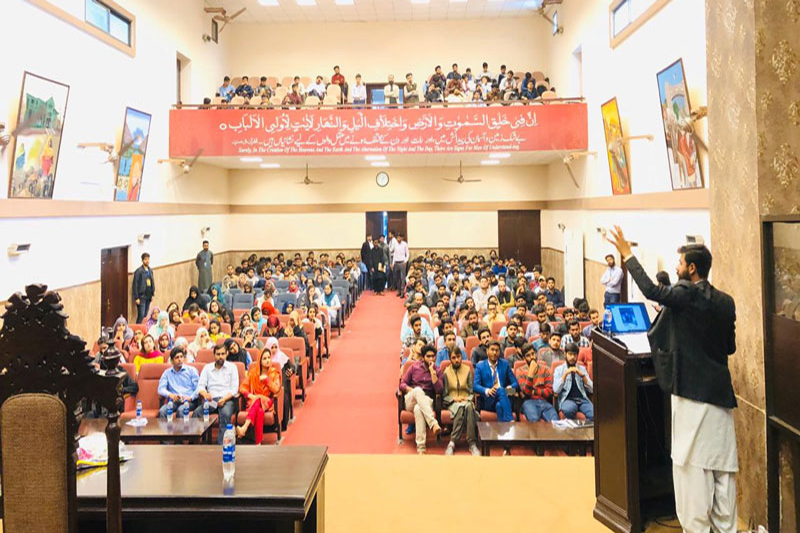
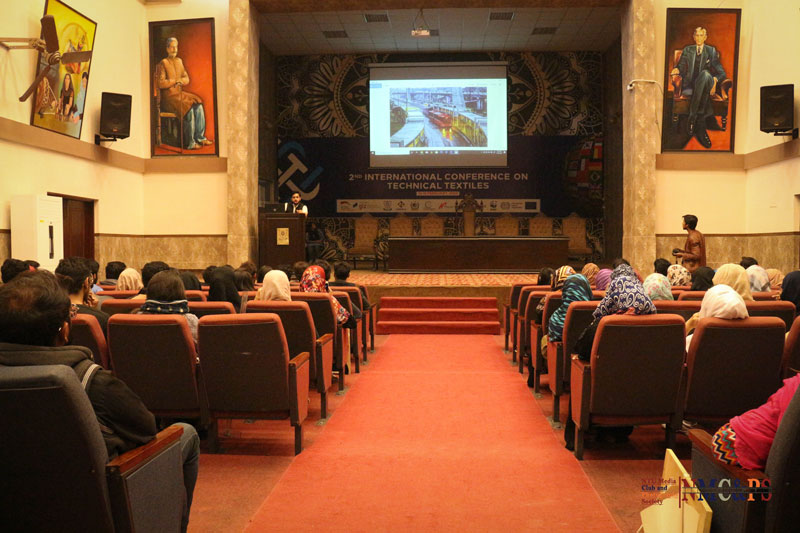
Auditorium
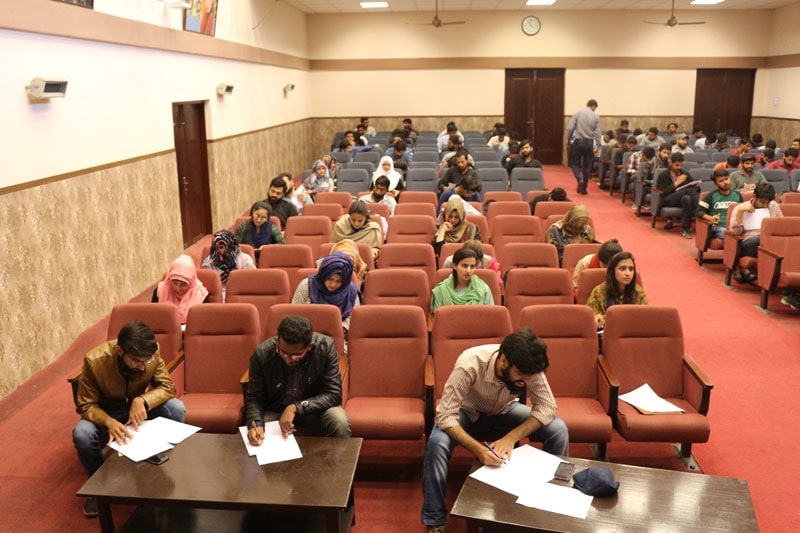
Class rooms
National Textile University
(Formerly NTCE) is the premier institution of Textile Education in Pakistan. The University campus is spread over an area of more than 62 Acres. The University is located in the outskirts of city of Faisalabad about 12 km from the city center on Lahore road.
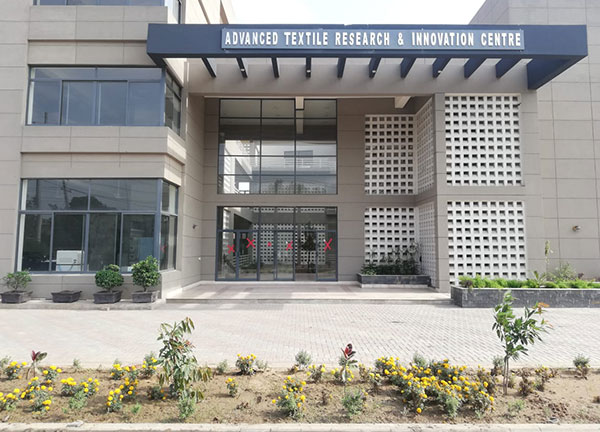
The purpose built campus includes the Administrative Section, Academic block, Laboratories, Computer Center, Library block, Auditorium, Air conditioning Plant, Faculty & Staff offices, Teaching Departments, Testing Lab, Mosque, Play Grounds, Students Hostels and Faculty & Staff residences
The University building comprises a double-story structure located in the front and is housing the Administrative Section, Basic Sciences Laboratories, Auditorium, Air-conditioning Plant, Conference Room, Computer and Textile Testing Laboratories, Lecture Halls and a New building for Library and Academic Staff. The rear block consists of departments of Yarn Manufacturing, Fabric Manufacturing, Textile Chemistry, Drawing Hall, Electronics Lab., new buildings for Mechanical Workshop and eight new Lecture Halls.
A comprehensive development plan worth about Rs. 20 millions for the construction of offices for faculty members, Administration block, Physics, Chemistry and Garments Manufacturing labs. is in the final stages of implementation.
The National Textile University (NTU) Library is providing excellent knowledge resources, services and facilities to fulfill the teaching and research needs of its faculty members, students, staff and a large number of the textile community in Pakistan. The library acquires a variety of resources regularly in print, audio visual and electronic formats to support study and research in the university.
The Library offers quality-oriented facilities to meet its objectives. It has a covered area of 6000 square feet to house collection and reading space. It has a seating capacity of 120 users through its study table/chair and individual study carrels. Construction of a multimedia section, and group study rooms is likely to complete within next three months.
Library Administration
Library Administration includes two professionals (Senior Librarian and Librarian) and four Para-professional staff members to fulfill the information needs of library patrons.
Library Collections
The library has collection of around 12000 books on different subjects including spinning, weaving, knitting, processing, mechanical engineering, mathematics, physics, dying, printing chemistry, electrical engineering, textile manufacturing, management, marketing, computer science, literature and other subjects in printed format. It also has access to over 20,000 online books through its computer terminals at http//onlinebooks.library.upenn.edu
Journals/Magazines
The library is subscribing to 19 international textile journals, and have bound archive of core textile journals some of them starting from 1918 to date.
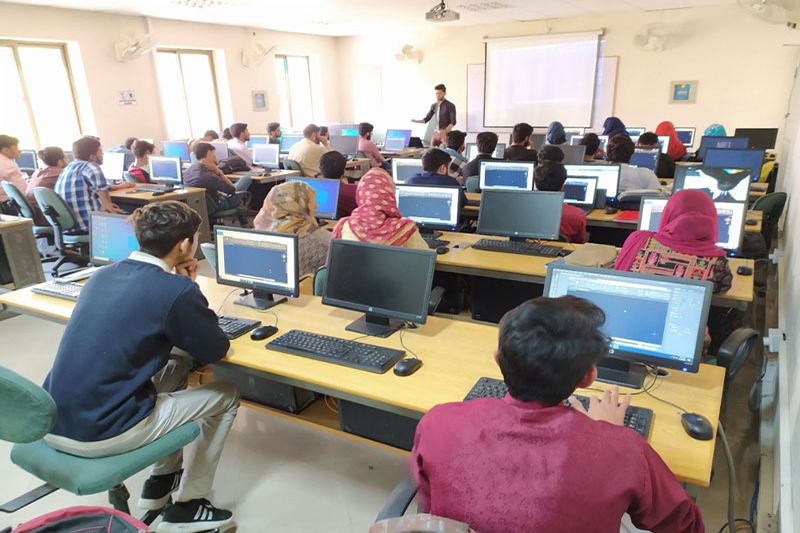
The primary objective of the Computer Center is to facilitate NTU students in their educational and training activities relevant to computers and I.T. and pertaining to the curriculum without any discrimination. Computer Center opts for an equal opportunity for all to learn individually as well as to collaborate with each other.
Computer Center is also responsible for the basic IT services and facilities for the entire faculty and staff. The secondary objective of the Computer Center is to create an environment in which the faculty and staff can communicate and collaborate effectively with each other during their time in the institute as well as to use the Information Super Highway and IT resources to be at par with the current technology, research and development work going on in this global village.
Infrastructure & Services
•
Servers: An Acer Altos 600 Server is the backbone of the IT framework in the University. With its dual PIII 900 MHz processors, integrated SCSI, RAID and Fast Ethernet link, it is used for DNS, Routing, User Authentication, SMPT & POP3 E-mail services and student profile storage. Other Servers are also linked in the domain for Internet caching and firewall, Printing and Library Database. State-of-the-art software technologies have been implemented on these servers using Windows 2000 Server Active Directory and Group Policies.
•
Local Area Network: A high speed 100Mbps Fast Ethernet LAN with Intelligent Switches with a total of 140 ports connect the computer systems throughout the University. The LAN is used by NTU faculty, staff and students for communication, resource sharing and online collaboration.
•
PC Lab: The PC Lab in the Computer Center consists of 40 PIII Windows 2000 Professional workstations. The University students exclusively use the PC Lab for their computing needs. High quality scanning, Laser Printing, Color Inkjet Printing and high-speed wide carriage dot matrix printing hardware is also available in the PC Lab.
•
Faculty / Staff Computers : Faculty and staff of the university are provided with PIII and PIV systems interlinked into the campus wide LAN. Each department is also provided with a laser printer for high quality printing. Along with laser printers, high-speed wide carriage IBM, Panasonic and Epson dot matrix printers are also provided to various departments for draft printing.
•
Satellite Internet : A 400Mbps Internet Downlink via satellite and uploading via V90 modem pool provides high-Speed Internet connectivity throughout the University.
Software
With the Microsoft Office 2000 Professional, NTU students, faculty and staff use different types of other software packages for their specific needs. Textile Engineering packages include Gerber Design Studio, Accumark and Usterstats. Other packages include Mathematica, Microsoft Visual Studio, Microsoft Encarta 2003 Reference Library, Dictionaries and Thesaurus, Typing Tutors, Corel Draw, Adobe Photoshop and utilities.
Website & e-mail
Computer Center manages the official website of the University www.ntu.edu.pk. It is regularly updated for latest information, news and events. NTU faculty, staff and students are provided with personalized web-based e-mail accounts that can be used from PC Lab, their office or their homes.
Information required

The University is a residential institution and has facilities to accommodate majority of students on the campus. There are two hostels for boys and an independent hostel for girls to accommodate about 350 students. Resident students are provided furnished accommodation comprising cubicles and dorms. Telephone lines are provided to every hostel. Each hostel is provided independent mess and common room.
Both the hostels have independent wardens from the resident senior faculty members. The hostels are modestly equipped with all basic facilities and furniture.

Most of the faculty and staff of the University are accommodated in the independent houses on the campus.
Back
|